
Battery-Electric Bus Fires: 10 CommonMisconceptions
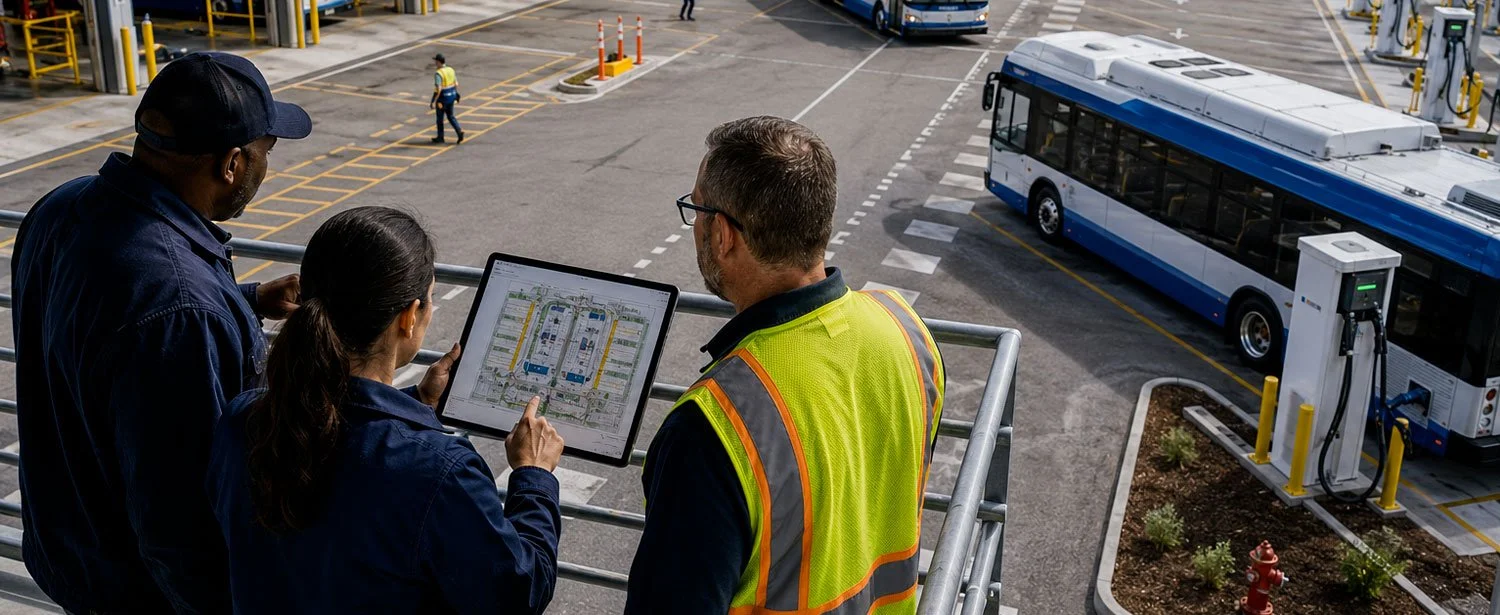
The useful BEB fire conversation lives between panic and complacency.
Battery-electric bus fires occupy a strange place in public conversation. One side treats them like proof that electrification is reckless. The other side waves away every concern as if new propulsion technology could not possibly introduce new operating risks. Transit agencies need a better middle ground.
BEB fire risk should be treated as serious, manageable, and specific. Serious because lithium-ion battery incidents can involve thermal runaway, reignition, stranded energy, and high-voltage hazards. Manageable because thoughtful detection, procedures, training, and facility planning can improve the agency's position. Specific because the risk profile is not the same as diesel, CNG, or hybrid operations.
The first misconception is that visible smoke is the starting point. For planning purposes, visible smoke is often late. Agencies should be more interested in abnormal thermal conditions that appear before smoke or flame.
The second misconception is that charging is only an infrastructure issue. Charging is also an operating environment. It involves vehicles, chargers, depot layout, software, utility power, staffing, and safety procedures.
The third misconception is that suppression is the whole strategy. Suppression matters, but detection, alert routing, isolation, responder coordination, and documentation matter too. A fire system that starts its useful work only at flame is starting deep into the event timeline.
The fourth misconception is that the route is always the highest-risk environment. A bus on route has public visibility and immediate human context. A bus parked in a depot may sit near other vehicles, connected to charging equipment, with fewer people nearby. Exposure is not always where the public sees it.
The fifth misconception is that all BEB fire events are basically the same. They are not. Cause, location, vehicle status, charging status, facility context, weather, system design, and response sequence all matter.
The sixth misconception is that “let it burn” is a strategy. It may be a defensive response decision under certain conditions. It should not be the agency's first clear plan.
The seventh misconception is that more data automatically means better safety. Data becomes useful when it is contextual, routed, understood, and connected to action. Otherwise, it is just evidence that a system was watching while people were still guessing.
The eighth misconception is that parked means inactive. A parked BEB may be charging, cooling, balancing systems, or simply holding stored energy in close proximity to other assets. The operating day may have ended, but the risk environment has not necessarily gone quiet.
The ninth misconception is that first responders only need the address. BEB incidents may require context about battery location, vehicle type, charging status, high-voltage hazards, access points, and facility layout.
The tenth misconception is that agencies can wait for final industry consensus before acting. The NFPA Fire Protection Research Foundation's work on lithium-ion battery transit bus fire prevention and risk management shows that guidance is still evolving. Agencies do not need to wait passively for a perfect playbook before improving detection, training, documentation, and depot planning.
This is the right leadership framing: BEB fire risk is not a reason to slow modernization, but it is a reason to modernize safety practices at the same time.
Troman's Trident™ Transit Fire System can be introduced carefully in that context. Trident is being developed to support earlier thermal awareness, staged alerts, and a more connected approach to transit fire-risk management.
The strongest position is neither alarmist nor dismissive. It is operationally sober: battery-electric buses are part of the future, and future fleets need safety systems built for the risks they actually carry.
Source links
USFA Emergency Response Guides for EVs and Lithium-Ion Batteries: https://www.usfa.fema.gov/blog/emergency-response-guides-for-electric-vehicles-and-lithium-ion-batteries/
NTSB Hamden BEB Fire Investigation: https://www.ntsb.gov/investigations/AccidentReports/Reports/HIR2403.pdf
NFPA Fire Protection Research Foundation BEB Fire Prevention Project: https://www.nfpa.org/education-and-research/research/fire-protection-research-foundation/projects-and-reports/lithium-ion-battery-transit-bus-fire-prevention-and-risk-management