Turn detector signals into a coordinated vehicle response.
Operator alerts, system supervision, and suppression control
Troman fire and gas protection control panels provide the operator with visual and audible system status while continuously supervising compatible detection and suppression equipment. Surface- and flush-mounted options place critical information and controls within the driver compartment.
When an alarm occurs, the panel can support operator actions and configured vehicle outputs, including audible warning, system delay, reset, equipment shutdown, engine derate or shutdown, hazard-light activation, evacuation procedures, and suppression discharge.
Troman fire and gas protection control panels supervise vehicle detectors and suppression hardware, warn the operator, and support configured emergency outputs when a fire, overheat, smoke, or gas condition occurs.
Clear status when the operator needs it
Use distinct indications for normal, trouble, and alarm conditions.
The panel communicates system OK, trouble, and alarm states through color-coded indicators and an external audible device. Driver controls can be configured to support delay, silence, reset, and suppression response according to the application.
Connect detection to the vehicle
Emergency outputs can coordinate more than the extinguisher.
The control panel can provide outputs to other vehicle systems so the response is not isolated from operations. The precise sequence should be defined with the vehicle builder, agency procedures, and suppression-system design.
Key capabilities
·Single- or dual-channel configurations
·Continuous detection and suppression monitoring
Compatibility with optical, gas, smoke, pressure, and thermal detectors
Visual and audible status indication
Configurable alarm delay and reset functions
Emergency-output support
Suppression activation after configured delay
Coordinate the complete response.
Troman can configure the panel around detector types, operator controls, vehicle outputs, suppression timing, and fleet procedures.
Download data sheet (PDF) →
Turn detector signals into a coordinated vehicle response.
Operator alerts, system supervision, and suppression control
Troman fire and gas protection control panels provide the operator with visual and audible system status while continuously supervising compatible detection and suppression equipment. Surface- and flush-mounted options place critical information and controls within the driver compartment.
When an alarm occurs, the panel can support operator actions and configured vehicle outputs, including audible warning, system delay, reset, equipment shutdown, engine derate or shutdown, hazard-light activation, evacuation procedures, and suppression discharge.
Troman fire and gas protection control panels supervise vehicle detectors and suppression hardware, warn the operator, and support configured emergency outputs when a fire, overheat, smoke, or gas condition occurs.
Clear status when the operator needs it
Use distinct indications for normal, trouble, and alarm conditions.
The panel communicates system OK, trouble, and alarm states through color-coded indicators and an external audible device. Driver controls can be configured to support delay, silence, reset, and suppression response according to the application.
Connect detection to the vehicle
Emergency outputs can coordinate more than the extinguisher.
The control panel can provide outputs to other vehicle systems so the response is not isolated from operations. The precise sequence should be defined with the vehicle builder, agency procedures, and suppression-system design.
Key capabilities
·Single- or dual-channel configurations
·Continuous detection and suppression monitoring
Compatibility with optical, gas, smoke, pressure, and thermal detectors
Visual and audible status indication
Configurable alarm delay and reset functions
Emergency-output support
Suppression activation after configured delay
Coordinate the complete response.
Troman can configure the panel around detector types, operator controls, vehicle outputs, suppression timing, and fleet procedures.
Download data sheet (PDF) →

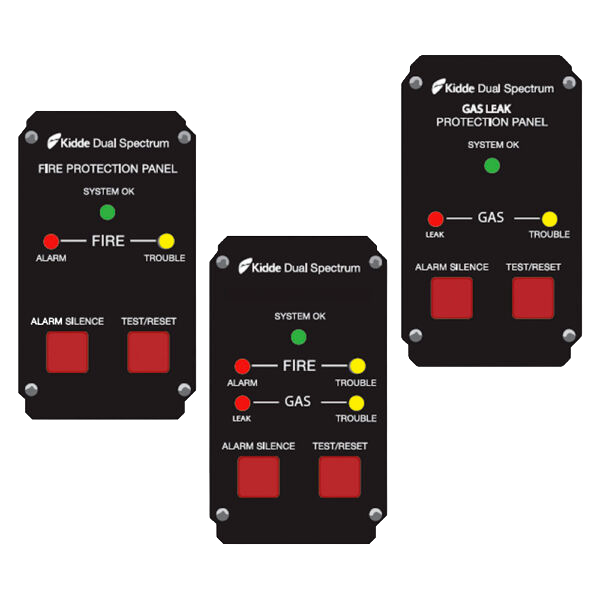 Image 1 of 1