
Fire suppression starts too late if detection starts at flame
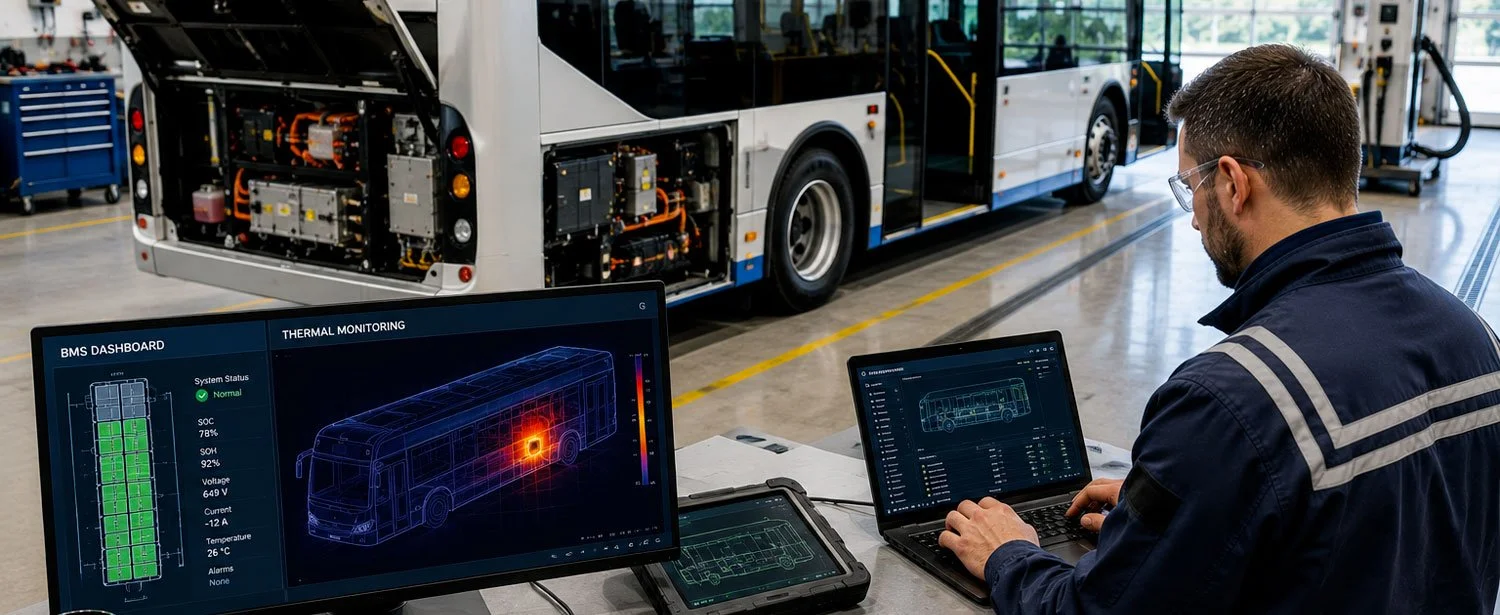
Suppression matters. But if detection starts at the flame, suppression starts with fewer options.
Fire suppression is important. It is also too often asked to do work that should have started earlier.
That is especially true in battery-electric bus environments. A BEB thermal event may involve battery systems, high-voltage equipment, charging infrastructure, thermal runaway, reignition risk, and responder safety concerns. The U.S. Fire Administration identifies electric shock, thermal runaway, battery ignition and reignition, and stranded energy as safety risks in electric vehicle and lithium-ion battery incidents.
Those risks do not mean suppression is unimportant. They mean suppression should be part of a layered strategy rather than the entire strategy.
A useful way to think about BEB fire mitigation is to separate the event into what happens before, during, and after visible fire. Before visible fire, the agency needs maintenance discipline, thermal awareness, and alerts that make sense. During escalation, it needs isolation procedures, suppression or cooling where appropriate, and clear communication to the people responsible for the facility and fleet. Afterward, it needs documentation, monitoring, and review so the organization learns something from the event or near-miss.
When all of that gets collapsed into “the fire system,” agencies can miss the real problem. A suppression system may work exactly as designed and still be operating late in the timeline. If abnormal heat went undetected, if alerts did not reach the right people, if adjacent buses were not moved, or if responders arrived without useful information, then suppression is being asked to compensate for earlier gaps.
That is not a fair assignment.
The layered model is not complicated, but it does require discipline. The first layer is prevention and maintenance. Agencies need inspection routines, charger reviews, fault tracking, and procedures that catch small problems before they become large ones. This is ordinary fleet discipline, but BEBs add new systems and data points that need to be folded into the maintenance culture rather than treated as someone else's software problem.
The second layer is early thermal detection. This is the point at which the agency looks for abnormal conditions before visible smoke or flame. Detection should be meaningful, not merely sensitive. Too much noise creates alarm fatigue; too little sensitivity creates late response. The goal is to recognize heat that does not belong and move that information into a useful workflow.
The third layer is alert routing. An alert that does not reach the right person is not much better than no alert at all. A bus on route, a bus in the maintenance bay, and a bus charging overnight may require different escalation paths. Maintenance, dispatch, facilities, and safety teams may need different information, but they should be working from the same incident reality.
The fourth layer is isolation and facility response. This is where BEB fire planning becomes more than a vehicle issue. If a bus is parked near other buses or connected to charging equipment, the agency needs to know who can secure the area, disconnect or manage equipment according to procedure, move adjacent assets if safe, and prepare for responder arrival.
The fifth layer is suppression or cooling where appropriate. This is the layer most people picture first, but it should not be the only one. Suppression decisions need to be grounded in the type of event, location, system design, and responder safety. The U.S. Fire Administration notes that lithium-ion battery fires can reignite even after extinguishment, which is why post-fire assessment and monitoring are important parts of response.
The sixth layer is responder coordination. First responders need more than an address. They may need vehicle type, battery location, charging status, shutoff information, access routes, facility layout, and known hazards. Emergency response guides exist because the first minutes of an EV or lithium-ion event can be complicated by missing information.
The final layer is documentation and review. A fire, warning, charger anomaly, or thermal near-miss should leave behind something more useful than a memory. Agencies need to know what happened, when it was detected, who was notified, what actions were taken, and what should change. Without that loop, the system may detect an issue without helping the organization improve.
Troman's Trident™ Transit Fire System can be positioned as part of this layered model. Trident is being developed to support early thermal detection, alerting, response coordination, and broader visibility across transit fire-risk environments.
The careful point is that Trident should not be described as magic. The better position is that BEB fire mitigation needs connected layers, and Trident is being developed to help agencies connect those layers earlier in the event timeline.
Suppression matters. But if detection starts at flame, suppression starts with fewer options. A better BEB fire strategy starts sooner.
Source links
USFA Emergency Response Guides for EVs and Lithium-Ion Batteries: https://www.usfa.fema.gov/blog/emergency-response-guides-for-electric-vehicles-and-lithium-ion-batteries/
USFA Lithium-Ion Battery Risks and Response Strategies: https://www.usfa.fema.gov/a-z/lithium-ion-batteries/risks-and-response-strategies/