
The hidden cost of not knowing
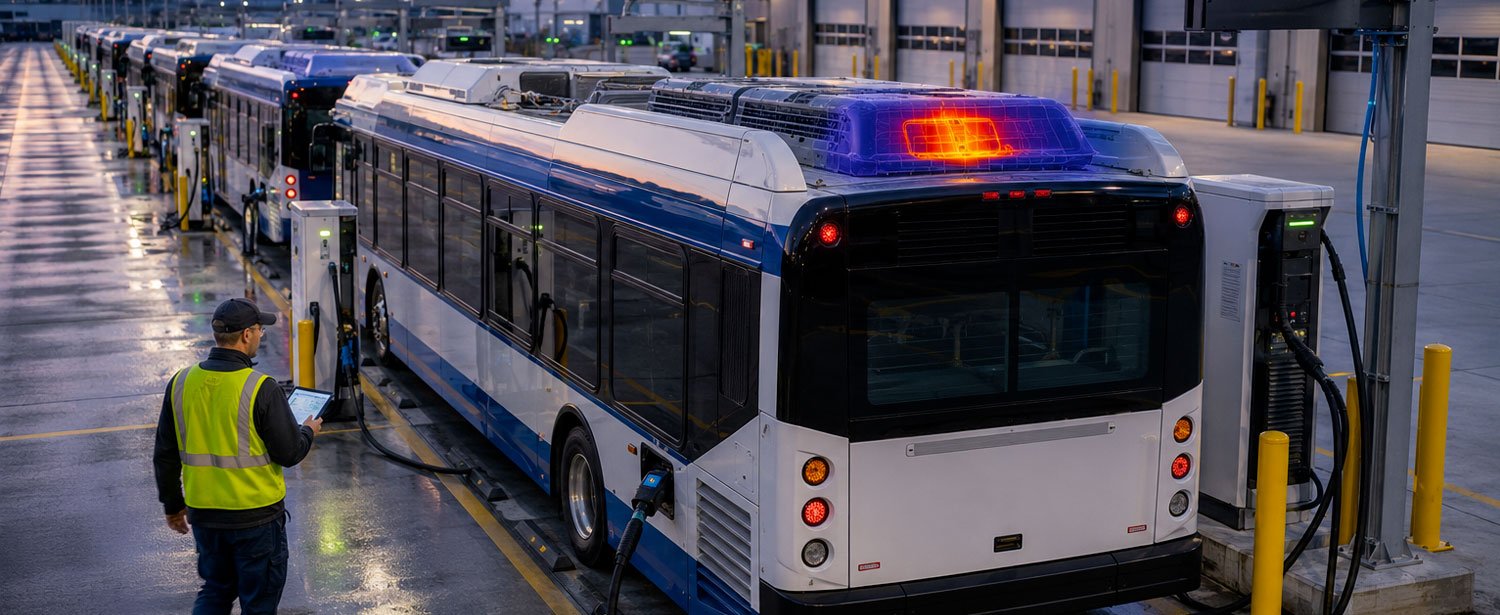
More fire-safety data only helps if it reaches the right people in a form they can act on.
Transit agencies already live with dashboards. Vehicle location, schedule adherence, charger status, maintenance work orders, parts inventories, and driver assignments all generate information. The problem is not that modern agencies lack data. The problem is that risk information can still arrive too late, in the wrong place, or without enough context to support a decision.
That distinction matters for BEB fire planning. A thermal event does not become easier to manage because a system captured a data point somewhere. It becomes easier to manage when the right people can see what changed, understand why it matters, and act before the situation narrows their options.
The NFPA Fire Protection Research Foundation has identified lithium-ion battery transit bus fire prevention and risk management as an area needing research and recommended practices. The project specifically recognizes the relevance of this issue to transit agencies, bus manufacturers, battery companies, facilities, and maintenance operations. That should get the attention of planning and procurement teams because it signals a developing category, not a fully settled one.
In a developing category, agencies should be careful about buying systems that only answer the most obvious part of the problem. A fire suppression device may be necessary, but it does not automatically solve the visibility gap. A thermal sensor may provide useful input, but it does not guarantee that the right people receive the right alert. A dashboard may display information, but it does not mean the information is actionable.
Useful visibility has a few traits. It identifies where the condition is happening. It separates routine conditions from abnormal ones. It routes alerts according to vehicle status and location. It connects vehicle-level events with facility-level consequences. It preserves a record that can be reviewed after the event or near-miss. Most importantly, it supports decisions rather than simply proving that a system noticed something.
For procurement and planning teams, that means asking different questions. Instead of asking only what a fire system detects, ask who sees the detection and what they are expected to do with it. Instead of asking whether the system has a dashboard, ask whether the dashboard helps maintenance, dispatch, facilities, safety, and responders work from the same incident reality. Instead of asking whether data is logged, ask whether the record is useful for maintenance trends, incident review, insurance documentation, and future training.
The hidden cost of limited visibility often shows up after the fact. A bus was parked in a vulnerable location, but no one realized the thermal issue was developing. A charger fault was treated as routine, but it repeated often enough to deserve review. An alert reached maintenance but not the facility team. Responders arrived with limited vehicle context. A near-miss cleared, but no one documented it well enough to learn from it.
None of those failures makes a dramatic headline by itself. Together, they form the quiet background of preventable confusion.
This is where Troman's Trident™ Transit Fire System can be positioned as part of a broader visibility strategy. Trident is being developed to support earlier thermal awareness, alert routing, and incident documentation across transit environments where vehicles, depots, and charging infrastructure overlap.
The credible position is not that more data automatically creates safety. More data can become more noise. The better position is that transit agencies need better risk visibility: timely, contextual, routed, and reviewable.
In BEB fire planning, not knowing is not a neutral condition. It is exposure waiting for a timestamp.
Source links
NFPA Fire Protection Research Foundation BEB Fire Prevention Project: https://www.nfpa.org/education-and-research/research/fire-protection-research-foundation/projects-and-reports/lithium-ion-battery-transit-bus-fire-prevention-and-risk-management