
Charging is not just charging anymore
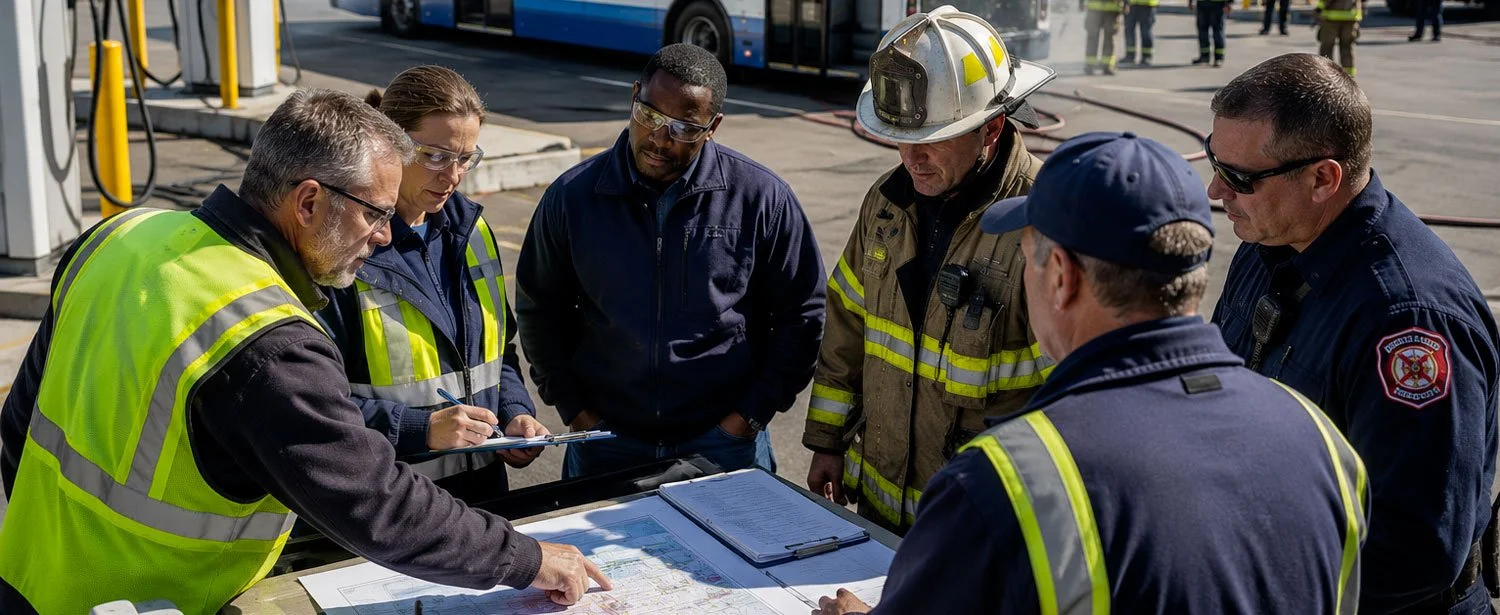
Charging is no longer just the thing that happens between shifts. For BEB fleets, it is one of the most important operating environments in the system.
Charging a battery-electric bus sounds simple until a fleet has to do it every day.
The vehicle has to return with enough state of charge to support the plan. The charger has to be available. The connection has to work. The schedule has to make sense. The software has to report accurately. The depot has to have enough space and power. Maintenance has to understand recurring faults. Operations has to know which buses are ready for pullout and which ones are not.
That is before anyone talks about fire-risk awareness.
For diesel and CNG fleets, fueling is usually a familiar task with well-understood procedures and relatively short dwell time. BEB charging is different. It can take hours. It can happen overnight. It can involve multiple vehicles staged in close proximity, connected to electrical infrastructure, and monitored through systems that may or may not give the right people the right information at the right time.
That makes charging a safety window as much as an energy window.
APTA's BEB charging infrastructure KPI document was developed to help agencies think about how charging infrastructure is performing and what indicators matter. While that guidance is not specifically a fire-risk document, it points to the bigger reality: charging is now part of operational performance. If charging performance is measured, managed, and reviewed, then charging-related safety visibility deserves the same seriousness.
A maintenance team looking at BEB charging has to think beyond whether the vehicle is full enough for tomorrow. It also has to care about recurring charger faults, failed sessions, unexpected interruptions, connection issues, unusual heat near the charging interface, vehicle-specific patterns, and whether certain bays or chargers generate more problems than others. A single failed charge may be a service issue. A pattern of abnormal charging behavior may be a maintenance clue. A charging condition paired with abnormal heat deserves more attention than either signal would receive alone.
This is where charging becomes a practical operations problem. The agency needs to understand what is normal for its fleet and what is not. Normal may vary by vehicle type, charger type, route history, ambient conditions, and dwell time. Without that context, teams are left with either too much noise or too little warning.
Neither is useful.
A system that alerts constantly without context will eventually be ignored. A system that stays quiet until smoke appears is not giving the team enough time. The useful middle ground is actionable visibility: enough information to distinguish routine charging behavior from a condition that deserves investigation.
That visibility has to be shared across roles. Maintenance may need technical detail. Dispatch may need to know whether a bus should be removed from the morning pullout plan. Facility teams may need to know whether a bay should be checked or isolated. Safety leaders may need documentation if a near-miss occurs. First responders may need charging status and vehicle information if the situation escalates.
The Federal Transit Administration's BEB deployment guide reinforces the idea that charging, maintenance, operations, safety, and infrastructure are connected in deployment planning. That connection should not end when the chargers are installed. It should continue into how agencies monitor, maintain, and respond to charging environments over time.
A practical BEB charging safety approach should answer several working questions. Are buses monitored while charging? Are abnormal thermal conditions routed to people who can act? Does the agency know which charger, vehicle, or bay is involved? Are after-hours alerts handled differently from daytime alerts? Are charging faults reviewed alongside maintenance and thermal-event data? Can a bus be isolated quickly if the situation changes?
Those questions are not theoretical. They shape whether charging remains a controlled operating process or becomes an after-hours blind spot.
Troman's Trident™ Transit Fire System can be positioned within that practical charging conversation. Trident is being developed to support earlier thermal awareness, alerting, and response coordination in transit environments where vehicles, facilities, and charging infrastructure overlap.
The careful claim is not that Trident solves every charging risk. It does not. The stronger claim is that BEB charging areas need better thermal-risk visibility because charging is now one of the most important operating environments in the fleet.
For maintenance and operations teams, the question is no longer only, “Will the buses be charged by morning?” The better question is, “Will we know if something changes before morning?”
Sources
APTA BEB Charging Infrastructure KPIs: https://www.apta.com/wp-content/uploads/APTA_BEB_charging_infrastructure_KPIs-Oct23.pdf
FTA BEB Deployment Guide: https://rosap.ntl.bts.gov/view/dot/68845