
The depot is the new fireground
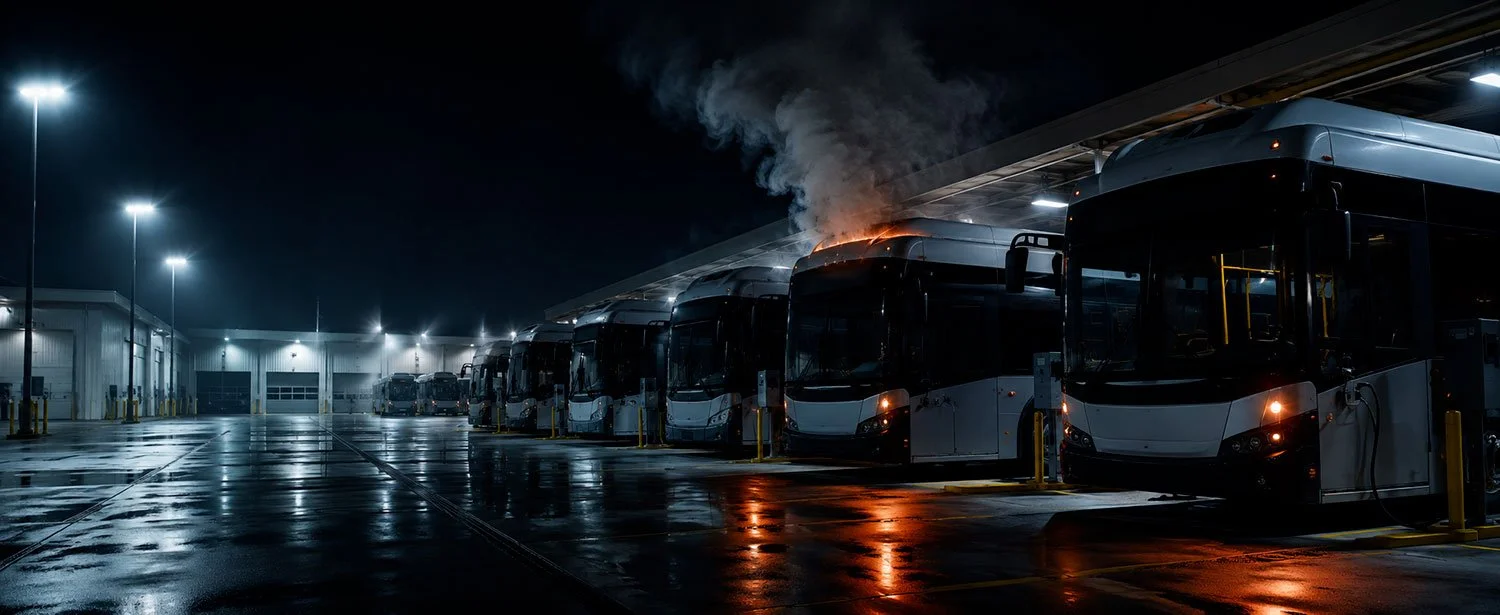
A depot fire-risk plan should not ask only, “How do we protect the bus?” It should ask, “How do we protect the operating environment around the bus?”
The most dangerous place for a battery-electric bus may not be the road. It may be the depot.
That sounds backward at first. Buses spend their public lives on the route. That is where passengers are, where traffic is, where weather and road conditions add uncertainty, and where an emergency becomes visible quickly. But visibility and exposure are not the same thing. In many ways, the depot is where BEB fire risk becomes most concentrated.
At the end of the service day, a transit agency gathers some of its most valuable assets into a relatively small footprint. Buses park near other buses. Charging equipment becomes active. Maintenance bays, parts storage, lifts, building systems, and employee work areas sit nearby. A single thermal event in that environment is no longer just a question of what happens to one vehicle. It becomes a question of what else is close enough to be affected.
That is the leadership-level issue behind BEB fire planning. A battery-electric bus thermal event can become a facility exposure, a service-continuity issue, an insurance matter, and a public-confidence problem before the morning pullout even begins.
The Federal Transit Administration's guidebook for deploying battery-electric buses is useful here because it does not treat BEB adoption as a simple vehicle purchase. The guidebook was developed to help transit agencies plan for deployment across infrastructure, maintenance, operations, safety, and workforce needs. That broader frame is exactly how fire risk should be handled. The bus, the charger, the depot, the maintenance program, the operating schedule, and the emergency response plan are connected whether an agency plans for that connection or not.
The fire service already recognizes that lithium-ion battery incidents can create response challenges beyond ordinary extinguishment. The U.S. Fire Administration notes that lithium-ion battery fires may involve reignition risk even after extinguishment and recommends post-fire assessment, continued monitoring, and safety zones. Those concerns do not become smaller when the vehicle is parked inside or near a facility filled with other revenue assets.
The practical executive question is not, "Are BEBs too risky?" That is the wrong question and a poor strategic posture for an industry moving toward electrification. The better question is, "Have we updated our risk model to match the fleet we are actually building?"
For many agencies, the answer may still be in progress. Fire planning may remain vehicle-centered even though the exposure is increasingly facility-centered. Charging areas may be treated as infrastructure assets rather than active safety zones. Depot layouts may be optimized for space and workflow without fully accounting for thermal-event isolation. Alert pathways may be designed for maintenance convenience, not for after-hours operational response.
None of this means agencies are negligent. It means electrification is changing the shape of risk faster than old planning categories can comfortably absorb.
A mature BEB depot fire plan should connect leadership, maintenance, facilities, dispatch, safety, and emergency response. It should identify where buses are stored and charged, what assets sit nearby, who receives alerts after hours, who can isolate a vehicle or charging area, how adjacent buses are protected, and what information reaches first responders before they enter the facility. These are not small technical details. They are the difference between treating a thermal event as a contained vehicle issue and discovering, too late, that it has become an operating environment issue.
This is also where Troman's Trident™ Transit Fire System can be positioned credibly. Trident is being developed around the idea that transit fire safety should not stop at isolated detection or suppression. The larger need is connected thermal-risk awareness: detecting concerning conditions earlier, routing alerts to the right people, supporting response logic, and helping agencies think about the vehicle and depot as part of the same safety environment.
The responsible claim is not that any system can eliminate BEB fire risk. It cannot. The stronger claim is that agencies need earlier visibility and clearer response pathways before a contained thermal condition becomes a wider operational loss.
For leadership, the conclusion is straightforward. A depot is not just a parking lot with chargers. It is a concentration of vehicles, infrastructure, people, schedules, and public obligations. As BEB fleets scale, the depot deserves to be treated as part of the fireground and part of the risk register.
Source links
FTA BEB Deployment Guide: https://rosap.ntl.bts.gov/view/dot/68845
USFA Lithium-Ion Battery Risks and Response Strategies: https://www.usfa.fema.gov/a-z/lithium-ion-batteries/risks-and-response-strategies/