
Before the flame: why abnormal heat is the real starting line
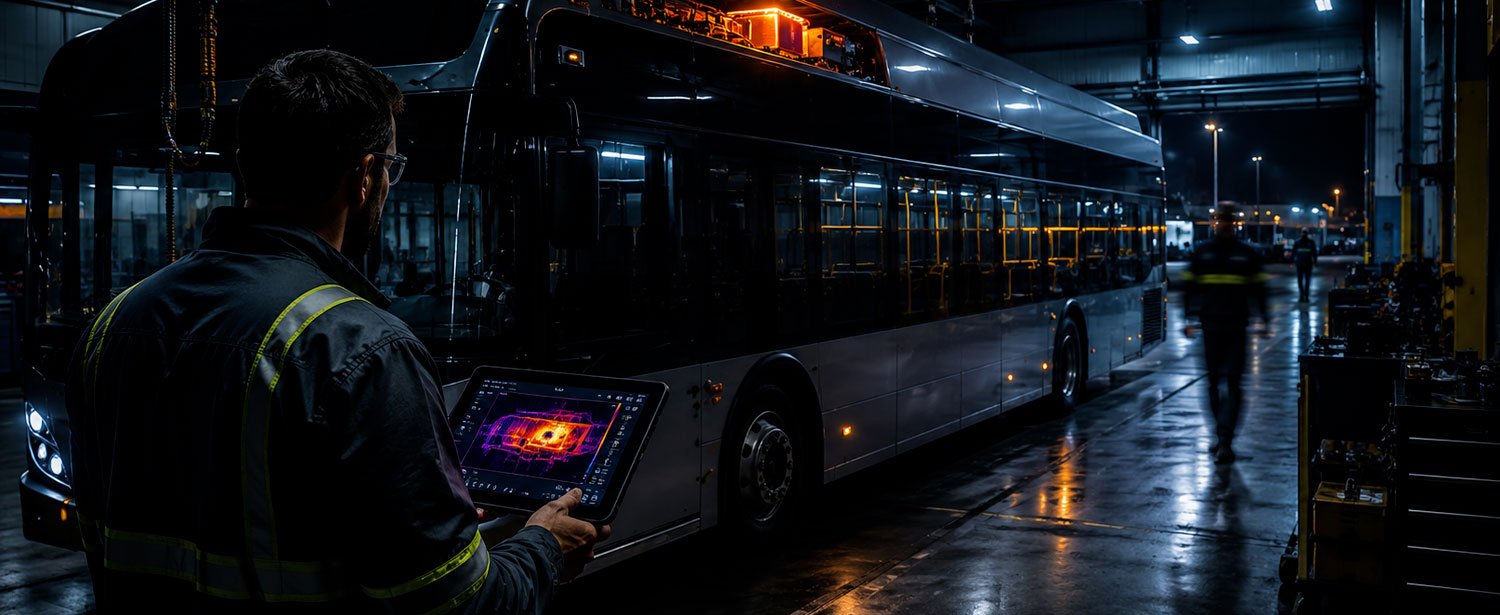
The goal is not to detect heat. The goal is to detect heat that does not belong.
Picture a bus returning from the last block of the day. The route is done, the operator turns it in, and the vehicle moves into the normal rhythm of the depot. Maybe it gets inspected. Maybe it gets parked. Maybe it gets plugged in. Around it, other buses are already lined up for the night, and the facility is shifting from daytime activity to a thinner after-hours crew.
Nothing looks wrong.
That is where the problem can begin for maintenance and operations teams. Not because every parked BEB is a threat, but because a useful warning does not always arrive dressed as an emergency. Sometimes it is a temperature trend. Sometimes it is a component that is warmer than expected. Sometimes it is a fault that looks minor until it becomes part of a pattern. Sometimes the issue is buried inside a system that cannot be judged by walking past the bus with a flashlight.
Visible flame is an easy signal to understand. It is also late.
The harder and more useful question is what the agency knows before that point. When a bus is parked, charging, cooling down, or sitting in a maintenance bay, what information is available to the people responsible for the fleet? Can they tell the difference between normal operating heat and heat that does not belong? Can they see where the abnormal condition is developing? Can they route the alert to someone who can act on it, instead of simply adding another piece of noise to an already noisy workday?
That distinction matters because BEBs are not cold machines. Batteries, chargers, HVAC systems, power electronics, brakes, and electrical cabinets all produce heat in normal operation. The goal is not to panic every time something gets warm. The goal is to recognize heat that is out of place, out of pattern, or out of proportion to what the bus is doing.
The NTSB's report on the Hamden, Connecticut battery-electric transit bus fire is a useful reminder of why outward appearances are not enough. In that investigation, the NTSB examined a non-crash battery-electric transit bus fire and found that moisture in the high-voltage lithium-ion battery system led to battery damage and fire. The report also addressed issues related to battery monitoring and emergency response information.
For a maintenance team, the lesson is not to assume every incident will look like Hamden. The lesson is simpler: the first meaningful condition may develop somewhere a person cannot easily see.
That changes the value of early thermal awareness. A driver needs clear instructions before a warning becomes a passenger issue. A dispatcher needs to know whether an alert is tied to a bus in service, a vehicle in the yard, or a charger-connected bus inside the facility. A mechanic needs location and severity, not a vague alarm. A facility manager needs enough information to decide whether to secure an area, check a charger, move nearby vehicles, or escalate to emergency response.
The words "early detection" can sound abstract until someone has to make those decisions. Then the practical details matter. Where is the abnormal heat? Is it in a battery area, electrical cabinet, wheel end, charger interface, or another monitored zone? Is the bus charging, parked, operating, or recently returned from service? Has this happened before? Did the condition clear, stabilize, or worsen? Who was notified, and what did they do?
If the answer to those questions is not available, the agency is left with a familiar maintenance problem: people are expected to act, but the information arrives late or incomplete.
This is where near-misses become important. A warning that does not become a fire is not necessarily a false alarm. It may be a maintenance clue. It may point to a recurring charger issue, a vehicle-specific condition, a pattern in post-route heat, or a procedure that needs tightening. A fleet that learns from abnormal conditions before they become incidents is in a stronger position than one that only learns from burned equipment.
Troman's Trident™ Transit Fire System is being developed for this earlier stage of the problem. Its role in the conversation is not to promise that every fire can be prevented. That would be the wrong claim, especially before live demonstration data exists. The stronger position is that maintenance and operations teams need earlier, clearer thermal-risk information they can actually use.
In practice, "before the flame" is not a slogan. It is a workflow question. It asks whether the agency can see abnormal conditions early enough, understand them clearly enough, and move them to the right people quickly enough to preserve options.
Visible flame creates urgency. Abnormal heat may create time. For maintenance and operations teams, time is usually the difference between a controlled response and a bad morning meeting.
Source links:
NTSB Hamden BEB Fire Investigation: https://www.ntsb.gov/investigations/AccidentReports/Reports/HIR2403.pdf