
What a near-miss can teach before the fire report exists
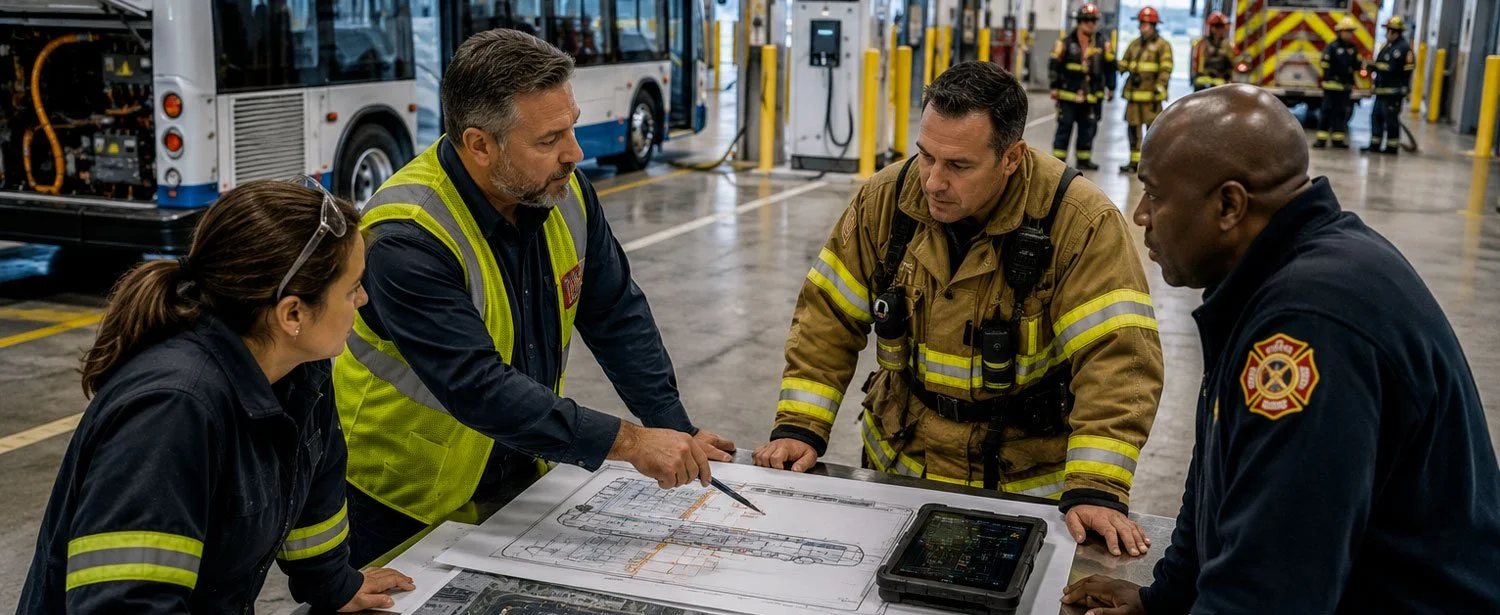
A near-miss is not nothing. Sometimes it is the system giving you a cheaper lesson.
Start with the best-case version of a bad moment.
A BEB returns from service and plugs in for the night. Later, an abnormal thermal condition appears in a monitored zone. The alert reaches the right people. Maintenance checks the vehicle, confirms that the condition deserves attention, and removes the bus from service for inspection. No fire occurs. No smoke enters the facility. No adjacent buses are damaged. The morning schedule is inconvenienced, but not wrecked.
It would be tempting to call that a non-event.
It would also be a mistake.
For maintenance and operations teams, near-misses can be more valuable than major incidents because they contain information without the full cost of failure. They show where a system noticed something, where a procedure worked or did not work, where communication slowed down, where documentation was weak, and where the agency may need to adjust.
A near-miss can be a thermal warning that never becomes smoke. It can be a charger anomaly paired with an unusual temperature pattern. It can be a repeated alert from the same vehicle zone over several weeks. It can be a maintenance discovery that changes how the agency inspects a class of buses. It can be an after-hours event that reveals the wrong people were on the alert list.
The NFPA Fire Protection Research Foundation has identified lithium-ion battery transit bus fire prevention and risk management as an area needing further research and recommended practices. That is relevant because agencies are still learning how to interpret and manage these events at scale. Formal guidance matters, but internal learning matters too.
The first step is deciding that near-misses count. If the only events worth documenting are confirmed fires, the agency throws away many of its cheapest lessons. A thermal alert that clears may still deserve review. A charger issue that repeats may still deserve trend analysis. A minor isolation procedure that feels clumsy during a low-stakes event may be exactly the thing to fix before a higher-stakes event.
The second step is preserving context. A near-miss record should answer the practical questions maintenance teams actually use: which bus, which zone, what operating state, what charger or bay, what time, what ambient or route conditions, who was notified, what action was taken, and whether the condition repeated. The goal is not paperwork for the sake of paperwork. The goal is memory.
The third step is closing the loop. If a near-miss leads to no review, no maintenance note, no procedure change, and no training update, the agency may technically have data but practically has learned nothing. A good near-miss process should make it easier to decide whether inspection schedules, charger procedures, parking layouts, alert thresholds, or response roles need adjustment.
This is where operations culture matters. People will not report or document near-misses if every warning becomes a blame exercise. They also will not take near-misses seriously if every alert disappears into a database nobody reads. The agency has to treat near-miss information as a tool for improvement, not a courtroom exhibit.
Troman's Trident™ Transit Fire System can be positioned as part of that learning loop. Trident is being developed to support earlier thermal awareness, alerting, and incident logging in transit environments where near-miss information can be operationally useful.
The careful claim is not that every near-miss predicts a fire. Most will not. The stronger claim is that agencies should not ignore the signals they are fortunate enough to receive before a serious incident.
A fire report tells you what happened after the loss. A near-miss record may tell you what to fix before one.
Source
NFPA Fire Protection Research Foundation BEB Fire Prevention Project: https://www.nfpa.org/education-and-research/research/fire-protection-research-foundation/projects-and-reports/lithium-ion-battery-transit-bus-fire-prevention-and-risk-management