
The first 10 minutes are an organizational test
The first 10 minutes do not create the plan. They reveal whether one exists.
In a battery-electric bus thermal event, the first 10 minutes are not only a fire-response window. They are an organizational test.
By the time people are moving quickly, making calls, opening doors, checking monitors, pulling up vehicle information, or guiding responders toward the right bay, the quality of the response has already been shaped by decisions made months earlier. Alert pathways, staff training, depot layout, vehicle information, maintenance procedures, and emergency contacts either work together or they do not.
That is why the first 10 minutes deserve more attention from leadership. They are the point where planning becomes behavior.
Imagine the event begins after hours. A BEB is parked in the depot and connected to charging infrastructure. An abnormal thermal condition appears in a monitored area. At minute one, the most important question is not whether the fire department has been called. The more immediate question is whether the right people inside the agency know what changed, where it changed, and what level of response the situation requires.
If the first alert is vague, the response slows down. If the alert goes only to a system nobody is actively watching, the response may not begin at all. If maintenance receives the warning but facility staff do not, the agency may know something is wrong with the bus while still failing to protect the surrounding environment. If dispatch knows there is an incident but cannot identify charging status or vehicle location, the first call to responders may be incomplete.
The U.S. Fire Administration identifies electric shock, thermal runaway, battery ignition and reignition, and stranded energy as safety risks in incidents involving electric vehicles and lithium-ion batteries. It also emphasizes the value of emergency response guides because responders need rapid access to critical information. Those points matter in transit because a BEB incident may involve not only a vehicle, but also a facility, charger, yard layout, and surrounding fleet.
The first 10 minutes can be thought of as a sequence of handoffs. The first handoff is from the vehicle or detection system to the agency. Something has changed, and the system needs to make that condition visible. The second handoff is from the agency's alerting process to the people who can act. Maintenance, dispatch, facility operations, and safety teams may all need different pieces of the same picture. The third handoff is from the agency to emergency responders, who need useful context before they are standing in front of a high-voltage vehicle with incomplete information.
When those handoffs are planned, the first 10 minutes can be controlled. When they are improvised, the incident starts collecting confusion.
That confusion has a cost. A bus may remain parked next to other vehicles longer than it should. Charging equipment may stay active while people debate who has authority to shut it down. Responders may arrive without knowing whether the bus is occupied, charging, or associated with a known fault. A facility team may not know whether to secure an area, move adjacent assets, or simply wait for instructions.
None of this requires a full fire to become a problem. Even a near-miss can expose weak handoffs. If an abnormal heat alert clears without escalation, but nobody documents it, the agency loses a learning opportunity. If the same zone triggers again two weeks later, but no one connects the dots, the organization has data without memory.
That is why the first 10 minutes should be designed before they are needed.
A strong BEB thermal-event plan should define what an alert means, who receives it, what information accompanies it, and what action is expected at each stage. It should distinguish between a bus on route, a bus in the yard, a bus in a maintenance bay, and a bus connected to charging equipment. It should include a clear escalation path for after-hours events. It should also determine what information first responders receive, including vehicle type, location, charging status, battery or high-voltage hazard information, and facility access details.
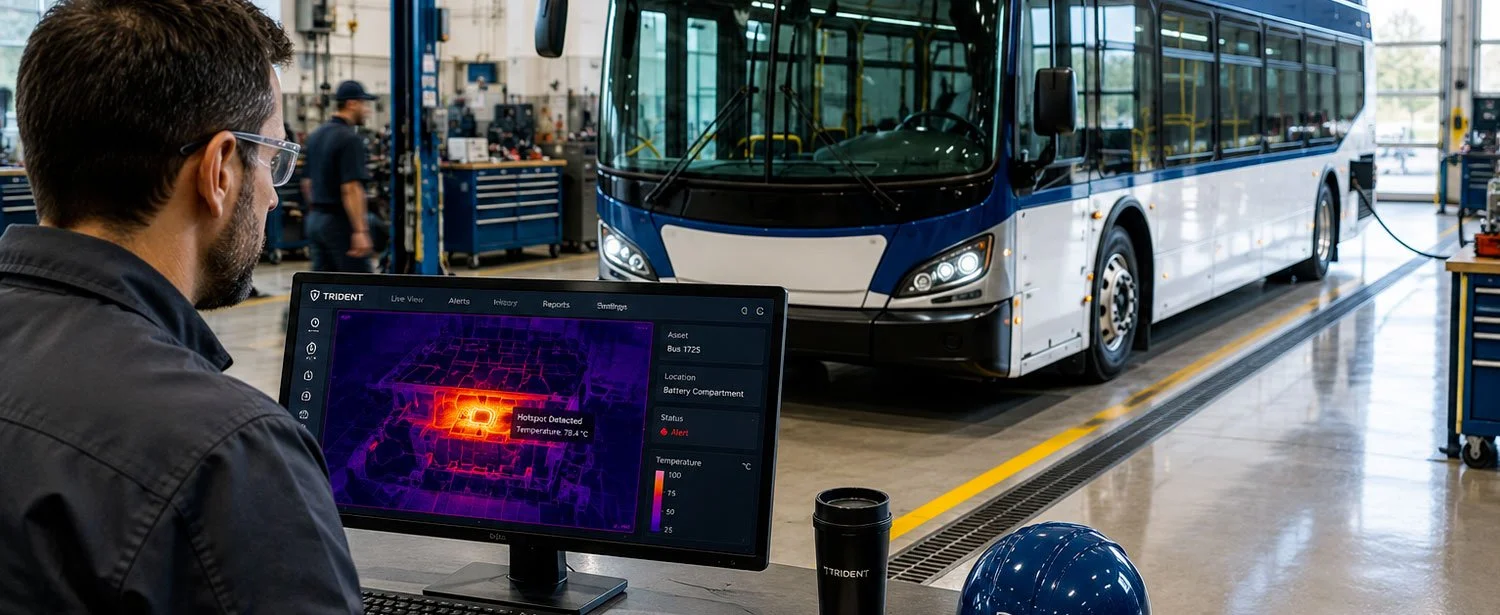
This is where Troman's Trident™ Transit Fire System can be framed as part of organizational readiness rather than just onboard equipment. Trident is being developed to support earlier thermal awareness, staged alerting, and coordinated response across transit environments.
The disciplined claim is not that any system can make the first 10 minutes easy. In a real incident, they will not be easy. The better claim is that the first 10 minutes can be less chaotic if the agency has better information, clearer roles, and practiced pathways.
A BEB thermal event does not wait for the organization to get organized. The first 10 minutes reveal whether it already is.
Source links
USFA Emergency Response Guides for EVs and Lithium-Ion Batteries: https://www.usfa.fema.gov/blog/emergency-response-guides-for-electric-vehicles-and-lithium-ion-batteries/