
The BEB fire question procurement teams should ask earlier
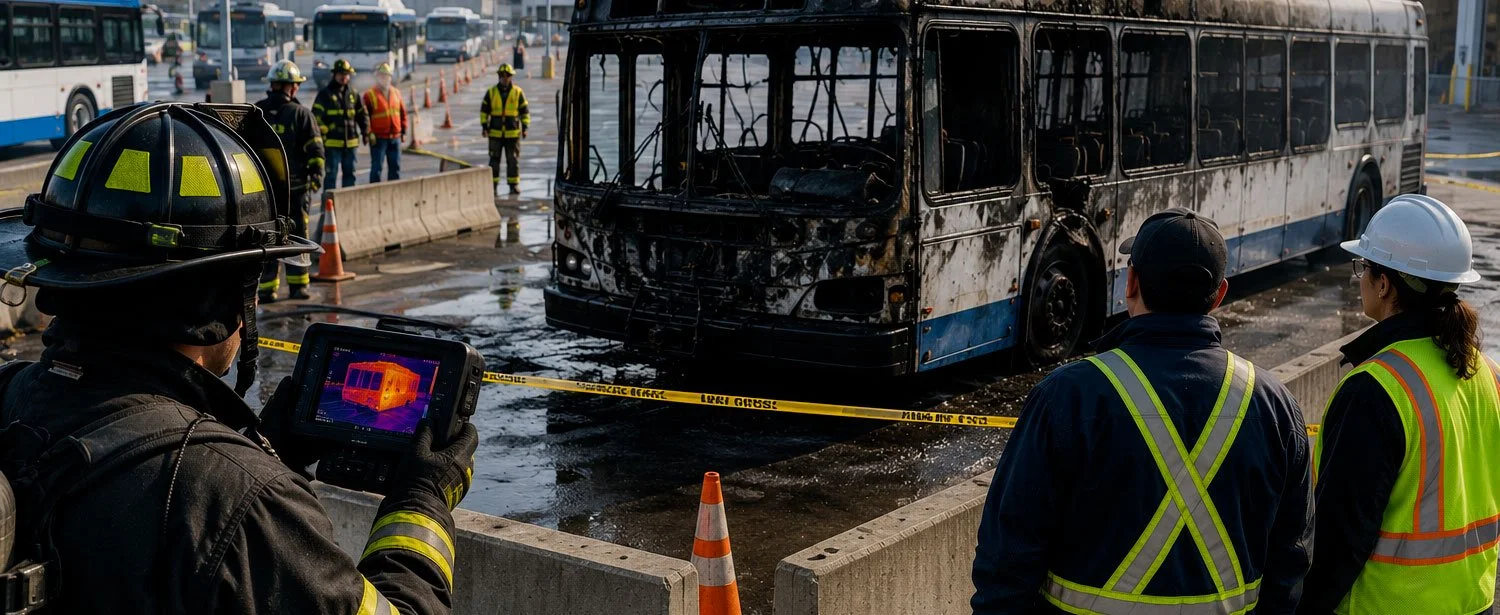
A procurement process can quietly decide the quality of a future incident response.
That may sound dramatic, but it is true. Long before a warning appears on a screen or a mechanic walks toward a bus, someone has already written the specification, evaluated the system, accepted the exclusions, selected the vendor, and defined what the agency is willing to pay for. By the time a BEB thermal event begins, the agency is living inside those earlier decisions.
That is why BEB fire system procurement should not be treated as a narrow equipment purchase. It should be treated as a cross-functional risk decision.
The NFPA Fire Protection Research Foundation has identified lithium-ion battery transit bus fire prevention and risk management as an active research and recommended-practices need. For procurement teams, that means the category deserves careful questioning. Agencies should avoid assuming that a familiar-looking fire system automatically answers the newer risks created by BEB fleets, charging areas, high-voltage systems, depot exposure, and after-hours operations.
A better procurement conversation begins with outcomes. What should the system help the agency know? What should it help the agency do? Who should it notify? What information should it preserve? How should it support responders, facilities, operations, and maintenance?
Detection is the first area to examine. Does the system identify only visible fire, or can it support earlier thermal awareness? Which zones are monitored? How does the system separate normal operating heat from abnormal conditions? Does the detection approach fit the way buses are used, parked, charged, and maintained?
Alerting is the next area. An alert is not useful simply because it exists. It has to reach the right people with enough context to support action. Procurement teams should ask whether alerts can vary based on vehicle status, location, severity, time of day, and agency role. A bus on route and a bus charging indoors do not create the same response need.
Facility integration deserves its own attention. A BEB fire system that treats the bus as an isolated object may miss the most expensive part of the problem. Depot layout, charging lanes, maintenance bays, adjacent vehicles, building systems, and after-hours staffing all shape the real exposure.
Maintenance and inspection requirements also matter. A system that is difficult to test, service, or document will eventually become a weak link. Agencies should ask how inspections are performed, how faults are reported, how event history is stored, and whether maintenance teams can use the information after a warning clears.
Responder coordination should not be left until the end of the process. The U.S. Fire Administration emphasizes the importance of emergency response guides for EV and lithium-ion battery incidents because responders need fast access to critical information. Procurement teams should ask what vehicle, battery, charging, and facility context can be made available during an incident.
Finally, documentation should be treated as a requirement, not an afterthought. BEB fire planning should learn from near-misses, alerts, charger anomalies, and confirmed incidents. If a system cannot help the agency reconstruct what happened, the organization may miss its best opportunity to improve.
Troman's Trident™ Transit Fire System should be positioned within this broader requirements conversation. Trident is being developed to support early thermal detection, alert routing, facility-aware response, and incident visibility for transit environments.
The careful claim is not that Trident is the only answer. The stronger position is that agencies should ask better questions before they buy any answer.
The cheapest system is not cheap if it only solves yesterday's fire problem.
Source links
NFPA Fire Protection Research Foundation BEB Fire Prevention Project: https://www.nfpa.org/education-and-research/research/fire-protection-research-foundation/projects-and-reports/lithium-ion-battery-transit-bus-fire-prevention-and-risk-management
USFA Emergency Response Guides for EVs and Lithium-Ion Batteries: https://www.usfa.fema.gov/blog/emergency-response-guides-for-electric-vehicles-and-lithium-ion-batteries/